
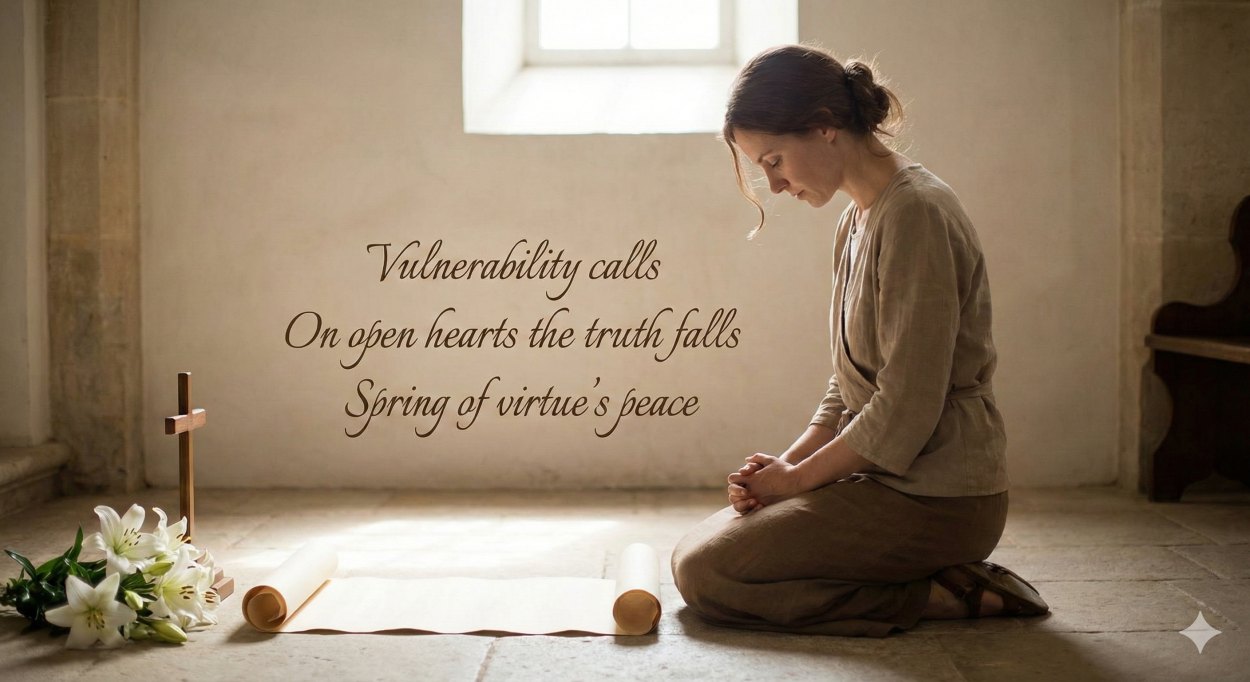
Vulnerability calls
Thomas C. Maples
On open hearts, the truth falls
Spring of virtue’s peace

Defining the V-Triad in Catholic Social Teaching
What if we are mistaken, and strength is just a small form of self-sufficiency unless it relies on something greater? What if true Virtue only happens when we build it on the bedrock of truthfulness and the courage to be vulnerable before God?
In The Dark Night of the Soul, St. John of the Cross points out how we often confuse strength with self-sufficiency. Here, I want to explore how the V-Triad—Vulnerability, Veracity, and Virtue—can guide us toward values that offer hope as we seek the light our spirit longs for.
The Call of Vulnerability: Breaking the Phantasy of Strength
“Thoroughly unprepared, we take the step into the afternoon of life. Worse still, we take this step with the false presupposition that our truths and our ideals will serve us as hitherto. But we cannot live the afternoon of life according to the program of life’s morning, for what was great in the morning will be little at evening and what in the morning was true, at evening will have become a lie.”
~ Carl Gustav Jung
(Jung 1969, para. 784)
Personal Reflections
We cannot live the later parts of life by the same rules followed when we were young. I’ve often heard an old saying, “God wastes youth on the young.” If you’re middle-aged or older, this likely feels true, even if you haven’t thought about it much before.
As my hair turns gray, I notice a shift from the role of Warrior to that of King. This transition unfolds within the context of my roles as husband, father, and son, surrounded by family and love. I’ve earned every one of those gray hairs. They tell the story of the joys, stresses, hard times, and good moments that have shaped my life. Were there mistakes? Of course. But as Jesus said:
“Let the one among you who is without sin be the first to throw a stone at her.” (John 8:7 NABRE)
By accepting our stories, we begin to view the many “Dark Nights” of our lives as steps leading toward a personal dawn. This brings us to an essential aspect of our journey: understanding our personal vulnerability. Let us explore the metaphor of the Warrior and the Wound.
Vulnerability: The Warrior and the Wound
“My grace is sufficient for you, for power is made perfect in weakness.” I will rather boast most gladly of my weaknesses,* in order that the power of Christ may dwell with me.
Therefore, I am content with weaknesses, insults, hardships, persecutions, and constraints, for the sake of Christ; for when I am weak, then I am strong. (2 Cor. 12:9 NABRE)
Everyone has scars. These marks reveal the harder lessons and pivotal moments that mold our character. The “morning of life” may be bright, but later days are colored by shadows. As we collect these wounds, they become the foundations of our unique story.
We all have an inner Warrior—the part of us that faces challenges when the world is not kind. Over time, the strength of youth gives way to wisdom. We build armor from these experiences, but eventually, that same armor leads us to the door of Vulnerability.
Like a Knight on a noble quest, we come to realize that to seek the truths of love, we must let ourselves be seen. Even a Knight has to lift his visor to face the day. Whether friend or foe, we cannot know at first. But in this act of greeting—this choice to open up—truth arises from that state of deep vulnerability.
The Veracity of Truth is Born
Everyone searches for the truth. Today, we often use “truth” to mean just being honest. But Veracity is deeper than simply choosing not to lie. When we see it as something active, we gain the power to choose what is good. Even a small realization can grow into something much larger, changing the very trajectory of a life itself.
Veracity as the “Truth of Being”
Veracity is the truth at the core of who we are. Jesus shows this truth in motion when he speaks to his followers:
“And you will know the truth, and the truth will set you free.” (John 8:32 NABRE)
This teaching goes beyond mere knowledge; it points toward receiving a great gift through our willingness to act in alignment with reality.
Lifting the Visor: The Knight’s Salutation
When the Knight lifts his visor, he shows real vulnerability. He is no longer hidden behind his armor. In the same way, our ego acts like armor—protecting us at first and buying us time to figure out whether the world is safe.
This openness is not a weakness; it is a turning point. It forces the warrior to look inside and face his own biases, feelings, or the shadows from a dark time that may still haunt him from that unconscious place.
Facing the Dark Knight
To face the “Dark Knight” within, we must look at our deepest wounds. It takes real courage to meet shadow beliefs—the conviction that we are unworthy of love, or the idea that strength is proved by never showing weakness. Opposite these shadows stands the virtue that calls us forward: faith in our inherent dignity. In this honest struggle, we build a strength of spirit, not just a hard shell, so common a trait to the armor adopted.
From Self-Pity to Veracity
We must recognize that vulnerability without veracity is just self-pity. Left unguided by truth, vulnerability can trap us, turning suffering into an ego-driven performance.
Pause for a moment: When you consider your own challenges, do you find yourself lingering in self-pity, or are you seeking truth to guide your vulnerability? Gently name where you are right now. By becoming aware of your stance, you open space for new growth. The V-Triad enables us to confront suffering authentically, moving us beyond the pull of self-centeredness to the virtue of Spring’s inner peace.
Welcoming the Spring of Virtue’s Peace
We all undertake a Hero’s Journey. A journey of inner strength that starts within.
An Exercise in Grounding:
Take a moment and breathe deeply, four or five times. Ground yourself. We are about to start a journey to welcome your inner hero. Begin when you feel a sense of lightness—that “sweet spot” of awareness.
Setting the Plot
Once grounded, write down your “inner myth.” What is calling you? What hero’s journey do you sense? It is there, ready to show you the virtue waiting to grow. Find the inner strengths your hero uses—wisdom, intelligence, perhaps a touch of “magic,” grace, or charm.
Maybe it is from this place that you can initiate your journey, descend into the labyrinth, pray upon, find direction, and ascend into that inner warrior within. In this space, ask yourself: What are you being called to leave behind during this most holy of Lenten seasons (or any journey that draws you into the wilderness of your soul)?
May blessings be with you as you write your own hero’s journey and advance confidently toward your dreams’ inner intent.
Bibliography
Campbell, Joseph. The Hero with a Thousand Faces. 3rd ed. Princeton: Princeton University Press, 2008.
John of the Cross, Saint. The Dark Night of the Soul. Translated and edited by E. Allison Peers. New York: Image Books, 1959.
Jung, C. G. The Structure and Dynamics of the Psyche. Translated by R. F. C. Hull. Vol. 8 of The Collected Works of C. G. Jung. Edited by Sir Herbert Read, Michael Fordham, and Gerhard Adler. Princeton: Princeton University Press, 1969.
United States Conference of Catholic Bishops. 2 Corinthians, Chapter 12. New American Bible, Revised Edition. Accessed February 19, 2026. https://bible.usccb.org/bible/2corinthians/12.
United States Conference of Catholic Bishops. John, Chapter 8. New American Bible, Revised Edition. Accessed February 19, 2026. https://bible.usccb.org/bible/john/8.
More from Dr. Thomas Maples

Please find me on Psychology Today
Unique Candle Collections


