
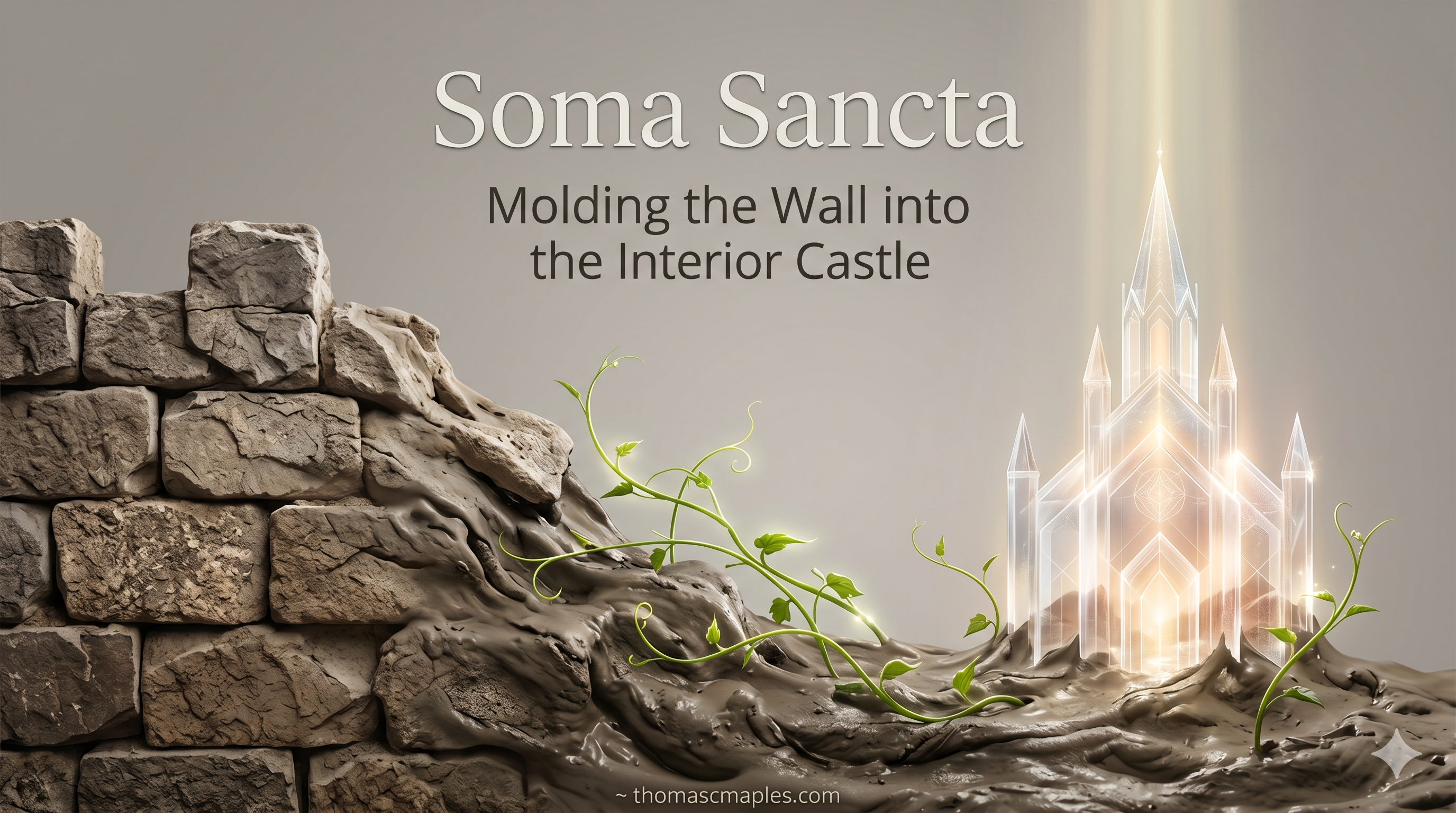
Rain sweeps mud to mold
~Thomas C Maples
Gentle voice calls soul to say
Springtime Spirit’s play
“And the Word became flesh and made his dwelling among us…”
Breaking Down the Wall
In our foundational inquiry into the Soma Sancta, we confronted a staggering truth: we do not merely inhabit a body like a ghost in a machine or a sailor in a ship. This journey inevitably leads us to consider the profound relationship between Somatic Dissociation and Spiritual Healing. As St. Thomas Aquinas famously posited, the soul is the very substantial form of our physical flesh—the spirit of God’s Word becoming flesh within and dwelling among us. Yet, in a modern landscape fractured by fifteen-second attention spans, unaddressed trauma, and chronic stress, we routinely forget this hylomorphic unity with the Triune God.
René Descartes and the Disincarnate Psyche
When René Descartes introduced his pivotal division between the thinking self (Res Cogitans) and the physical world (Res Extensa), humanity began a long, philosophical pilgrimage down the path of a Disincarnate Psyche. The soul was relegated to a mere ghost trapped inside a separate, biological machine, creating a definitive split between that which thinks and that which exists—or extends into physical space.
This dualistic ideal constructs nothing more than bricks in a defensive wall, dissecting the sacred whole with the scalpel of a secularized intent, bent on shattering the image of the Triune whole into finite and fragmented parts. The reality of being made in God’s image is simply overshadowed by creation when humanity’s aim seeks to assume the creative force itself.
The Architecture of Psychological Defense
Yet, the architecture of our psychological defenses—the rigid walls and armor we erect for survival—does not have to remain a permanent prison held within the Cartesian Hell we last explored. Through intentional practices that challenge and dissolve our preconceived boundaries, we can soften the rigid somatic realities underlying the bricks of our dis-ease. In doing so, we begin to mold the wall into the Interior Castle—that brilliant, crystalline tabernacle where the Imago Dei shines in its full, fully alive glory.
Somatic Dissociation and Spiritual Healing of the Disincarnate Psyche
Faith heals in mysterious ways. Perhaps this is because through that invisible, all-pervading force, physiological harmony can co-exist with the greater weight of God’s calling—the One in whom, with whom, and through whom we find our grounded solace. One of the most profound examples of this symbiotic, existential reality occurs in the story of the hemorrhaging woman, whom Jesus cured of a chronic physiological affliction that had outcast her from her community:
A woman suffering hemorrhages for twelve years came up behind him and touched the tassel on his cloak. She said to herself, “If only I can touch his cloak, I shall be cured.” Jesus turned around and saw her, and said, “Courage, daughter! Your faith has saved you.” And from that hour the woman was cured.
While this narrative presents a striking example of physical distress transfigured by grace, Carl Jung reminds us that the boundaries between the physical and psychological are entirely porous:
“The soul and the body are not two distinct things, but one and the same life… Psychical uniqueness and physiological uniqueness are not a duality, but rather the expression of a single organic whole.”
~ C. G. Jung (1968, 30)
When we dissociate, we actively remove ourselves from the very physiological reality that cures our dis-ease: the energetic wavelength of the Spirit, that internal and external hope that links us directly to the Imago Dei with whom we strive to unite. Somatic dissociation is not merely an abstract, dualistic division between that which thinks and that which extends; it is a severing of the umbilical connection between the branch and the Vine.
To bear good fruit, we must inhabit the whole of the ground that nurtures us within. This includes the “shadow matter”—the dense, painful history that serves as the fertilizer life has provided. It requires us to look honestly at the heavy armor and the rigid bricks we have laid down to fortify ourselves against the hardships of a broken world, as we learn to work the bricks of the wall into the sanctum sanctorum of our Interior Castle.
Rain Sweeps Mud to Mold: Re-Configuring the Soma-Sancta
“Water is fluid, soft, and yielding. But water will wear away rock, which is rigid and cannot yield. As a rule, whatever is fluid, soft, and yielding will overcome whatever is rigid and hard. This is another paradox: what is soft is strong.”
~(Lao Tzu 1988, chap. 78)
We are born as a blank slate. Or are we? The very foundation of our being is preconceived, even though it may not have yet manifested in the being that was conceived and brought into existence in that first moment of life. Yet, everything was present in that distinct instant—right down to the hair on your head, and the hair you will eventually lose.
It is in the decisions we make between the first and last moments of life where we have the unique opportunity to unite with and strengthen the Soma Sancta, transforming the soul into the unified being it was already eternally preconceived to be. You are you, and you have been you since the exact moment your soul entwined with the deoxyribonucleic acid (DNA) sequence that forms every cell of your body.
Yet, it takes a soft, fluid persistence to mold that which has become rigid and hard into the malleable matter that will form the true building blocks of the Interior Castle. Our body is a sacred tabernacle. We must breathe the Ruah of life back into it, refusing to abuse it for the defensive purposes of a disenfranchised mind.
When we learn to work with our physical form rather than against it, we slowly cultivate the strength needed to mold the ghost and the machine into something infinitely greater than their individual parts, where the unified whole can bring solace and inclusion to the divergent parts cut under the scalpel of division. Let us now examine the gentle voice that molds holy mud into sacred space.
Gentle Voice Calls Soul to Say: Molding Holy Mud into Sacred Space
“The Father spoke one Word, which was His Son, and this Word He always speaks in eternal silence, and in silence must It be heard by the soul.”
~ St. John of the Cross (1991, 90)
We all erect walls. It is a difficult, if not surgically precise task to lower those defensive structures once they are built. After all, it is those very boundaries that initially protect the soul—that most vulnerable creature whose feelings are starkly real. Yet, those same protective barriers can ultimately imprison us. They create a closed-off space where even the Spirit cannot penetrate. When fully embodied, this prison manifests as the physical, somatic crystallization of our archived psychic defense system.
The ego exists here, but as with all psychological constructs, it is not inherently evil. It is simply part of the raw ingredients that, once broken down and hydrated by grace, forms the resilient mud the Potter uses to fashion a sacred space.
Icarus and the Unintegrated Ego
Yet the unintegrated ego, much like Icarus—the high-flying son—refuses to listen to the Father. It takes to flights of fancy, soaring higher and higher until its wings melt against the sun. This tragic ascent occurs when we allow ourselves to be consumed by the noisy mental chatter, frantic intellectualizations, and collective projections that the modern person craves. The ego flies upward into the disincarnate safety of the head, but to what end? Left unchecked, it leads only to our own psychological demise.
Quieting the Mind
True consciousness cannot emerge from this manic form of cleverness. When the soul finally quiets, it realizes that inner peace is never an external acquisition. The internal landscape must simply be stilled to hear what has been there all along. The Father speaks only one Word, and because it is spoken in eternal silence, the frantic ego can never decipher it.
It is only down in the dark recesses of our somatic density that the Potter quietly works. He grounds us, dissecting us from our flights of fancy. This process anchors us in the true, creative depths of the body, where the soul may ultimately break free from its chains in creative bliss.
“Highest consciousness is not cleverness, but a wide and deep looking that encounters the dark, creative silence of the soul.”
~ C. G. Jung (1973, 1:377)
Springtime Spirit’s Play: Somatic Dissociation and Spiritual Healing of the Interior Castle
I say, follow your bliss and don’t be afraid, and doors will open where you didn’t know they were going to be.”
~ Joseph Campbell (1988, 120)
1. The Breath of Life: Engage the Inner Spirit
Ruah. Let us take just one minute to return to the Holy Spirit—the Lord, the Giver of Life. We must remember our origins:
“Then the Lord God formed the man out of the dust of the ground and blew into his nostrils the breath of life, and the man became a living being.”
It is up to us to return to this foundational place, utilizing the breath of God to calm the frantic, nervous architecture of a disincarnate psyche.
- The Posture: Sit or lie down. This somatic meditation does not need to take an eternity. It requires only two to three minutes to breathe in and consciously spark a profound spiritual movement within the flesh.
- The Scan: Close your eyes and scan your body. Locate the tightest, heaviest brick currently present in your defensive wall. Is it locked within your shoulders, your jaw, your chest, or your traps?
- The Inhale: Breathe deeply down into the abdomen. Allow the breath to radiate outward from your center, hydrating the dry dust of that targeted tension.
- The Exhale: Release each exhale with a full, vocalized sigh: “Ahhhhh.” Feel the unexpressed grief, stress, and survival energy release. Let the physical sound wave moves through your tissue from the inside out.
- The Hylomorphic Goal: This intentional sigh sends an immediate physiological signal of safety to your vagus nerve. It instantly down-regulates the sympathetic nervous system. In doing so, you break down the brittle, calcified tension of the brick. Feel it as it melts back into the malleable mud required to rebuild your inner sanctum.
2. Tending the Branch and Honoring the Vine
“Remain in me, as I remain in you. Just as a branch cannot bear fruit on its own unless it remains on the vine, so neither can you unless you remain in me. I am the vine, you are the branches. Whoever remains in me and I in him will bear much fruit, because without me you can do nothing.”
~ John 15:4–5 (NABRE)
Stressed out? It is time to let it go. Pause for just a few moments longer. You have had a hectic day, and it is finally time to let it slip away.
- The Posture: With your eyes gently closed, settle your weight entirely into your chair or your feet. Feel the heavy, supportive density of the earth beneath you.
- The Visualization: Picture your spine as the central Vine, with the rest of your body forming the branches that extend outward from this sacred focal point. You are the vibrant branch meant to bear much fruit, grounded securely to that central Vine within, as you feel the heavy peace of your feet planting you firmly in place.
- The Cadence: Find your own unique inner rhythm, inhaling and chewing over your breath by counts of four, five, six, or seven. The exact timing does not matter; this is your natural biological rhythm operating in perfect unison with Christ.
- The Inhale: As you breathe in, visualize the light of the Spirit radiating from your lungs throughout your entire body, filling every cell with the divine grace of an integrated consciousness.
- The Exhale: As you breathe out, feel your systemic tension release into this light, expelling the dark corners of the day’s stress as it grounds you back into this fertile, life-giving grace.
- The Hylomorphic Goal: Remain in yourself. Who else is better equipped to know you than you yourself? By forcing your mind (attention) to actively dance with your biology (respiration), you bridge the Cartesian split, ensuring your branch remains dynamically connected to the only Source that can sustain the spirit’s essence in hope and faith.
3. Tending the Storms of the Soul: Spiritual Healing for Somatic Dissociation
“You have made us for yourself, O Lord, and our heart is restless until it rests in you.”
— St. Augustine (2008, 3)
You probably have a smartphone in your pocket. Have you ever logged your mood? On native platforms like Apple Health, there is an intuitive mood logging feature where you can track your emotions for the moment or your overall baseline for the day. If you are on an Android ecosystem, highly rated third-party applications like Daylio Journal provide a similar digital environment to map your daily emotional variations.
- The Routine: Commit to checking in at least once a day using these digital mirrors.
- The Step: Follow the simple prompts on your phone regarding your mood. Identify your current emotional state and quietly contemplate what influences brought you to that space today.
- The Reflection: Ask yourself two basic questions without overthinking the answers:
- What is my psychological and spiritual weather pattern right now? (e.g., Anxious, cloudy, foggy, windy, or rushed)
- Where do I physically track that pattern in my body? (e.g., A tight band across my forehead, a heavy weight on my chest, or a nervous knot in my stomach)
- The Hylomorphic Goal: Activate the Watchtower of witness consciousness. By naming the emotion and locating its distinct physical footprint, you systematically halt somatic dissociation. You engage an age-old, mindfulness-based exercise that fundamentally increases emotional intelligence and psychological health through rapid self-identification.
4. Cleaning the Temple: The Intent of Nutrition
“Do you not know that your body is a temple* of the holy Spirit within you, whom you have from God, and that you are not your own? For you have been purchased at a price. Therefore, glorify God in your body.“
What better way to honor God than to give explicit thanks to the materials that nurture your physical form? Reframe at least one meal today. Create it as an intentional act of altar preparation rather than a rushed afterthought. When it is complete, offer gratitude for the spirit that sparked its culinary inspiration.
- The Selection: Intentionally select whole, unadulterated foods—vibrant colors, clean proteins, pure natural oils, and filtered waters.
- The Focus: Actively honor God’s creation reflected in this medley of natural colors on your plate.
- The Presence: Cook and consume this meal entirely without secondary digital distractions.
- The Cadence: Slow down your pacing to fully taste, texturize, and savor each individual bite.
- The Hylomorphic Goal: Treat your body as an authentic, sacred tabernacle. Clearing out systemic inflammation and creating optimal presence through nutrition allows the Imago Dei to radiate through your physical form with maximum energetic vitality.
🕊️ The Daily Reminder
“The glory of God is a human being fully alive.”
— St. Irenaeus
By engaging in these playful building blocks, you cease your exile as a disincarnate ghost hovering over a biological machine. You step back into the ground of your history, transforming your flesh into an Interior Castle—a holy paradise where the Creator finds His absolute delight and eternal play.
Coming Home to the Interior Castle
The pilgrimage away from the Cartesian Hell does not require us to wage a violent war against the very psychological fortifications we built to survive a fractured world. The Soma Sancta framework is our direct clinical and theological answer to the rigid, armored bricks of our survival defense mechanisms. Through its intentional practices, we systematically break down those unyielding stones into a pliable, hydrated mud.
Once softened, this clay becomes workable, allowing us to actively reshape our physical form into an interior castle uniquely suited for our inner state of grace to communicate freely with God’s overarching plan. It is within these deep, sacred mansions of the soul where the true image of the Self can gently touch upon the childlike structures of the ego, and Divine Grace can be fully assumed.
With blessings, my friends. May you find true grace and somatic spiritual healing on your unique journey to advance confidently in the direction of your dreams.

Bibliography
- Aquinas, Thomas. 1948. Summa Theologiae. Translated by the Fathers of the English Dominican Province. New York: Benziger Brothers.
- Augustine. 2008. Confessions. Translated by Henry Chadwick. Oxford: Oxford University Press.
- Campbell, Joseph. 1988. The Power of Myth. Edited by Betty Sue Flowers. New York: Doubleday.
- Confraternity of Christian Doctrine. 2011. The New American Bible, Revised Edition (NABRE). Washington, DC: United States Conference of Catholic Bishops.
- Irenaeus. 2001. Against Heresies. In The Ante-Nicene Fathers, edited by Alexander Roberts and James Donaldson, vol. 1. Grand Rapids, MI: Wm. B. Eerdmans Publishing.
- John of the Cross. 1991. The Collected Works of St. John of the Cross. Translated by Kieran Kavanaugh and Otilio Rodriguez. Washington, DC: ICS Publications.
- Jung, C. G. 1968. Analytical Psychology: Its Theory and Practice. New York: Pantheon Books.
- Jung, C. G. 1973. Letters. Edited by Gerhard Adler and Aniela Jaffé. Translated by R. F. C. Hull. Vol. 1, 1906–1950. Princeton: Princeton University Press.
- Lao Tzu. 1988. Tao Te Ching. Translated by Stephen Mitchell. New York: HarperPerennial.
More from Dr. Thomas Maples

Find me on Psychology Today
Unique Candle Collections


